News

What Is Left for Humans to Do?
Mati Mõttus
Lecturer in Computer Perception, Tallinn University
Robots are here to stay in industry: they can work tirelessly, detect what the human eye cannot see and respond to danger faster than we can. Yet robots still cannot judge whether their actions are sensible, ethical or even necessary. The more tasks we hand over to machines, the more pressing the question becomes: what is left for humans to do?
It has become quite common to find production facilities with no people in sight. Robots assemble cars, manufacture electronic components and run entire production lines. Sometimes, the equipment produced automatically then goes to work in environments where there are no people either.
Does this mean humans are no longer needed? I do not think so. The human role may have become less visible in some areas, but it has not disappeared from the system.
People are involved in production in many ways
Even when a production line operates fully automatically, someone needs its output. We must first consider the end user: is the finished product useful, usable and necessary for them? Its appearance and how enjoyable it is to use may also matter.
For example, someone has to decide that it is time to manufacture red cars. A robot can assemble a car with great precision, but it does not decide what kind of car a person wants. When I bought my last car, I struggled to find a red one. This is a simple example of how automated production begins with human needs and preferences.
Another key stakeholder is the business owner, for whom the cost of the production line and the return on investment matter. There is a threshold beyond which using robots becomes worthwhile, while below it, hiring people is cheaper. This is why much production is still relocated to regions with lower labour costs rather than to fully robotised factories built in America or Europe.
We must also consider the people who operate and maintain the system. For them, the production line’s performance, manageability and reliability are important. Can we trust a robot to carry out its tasks? How much can it do? How often does the system need maintenance, and who steps in when something goes wrong?
Finally, automation also has a social and political dimension. We must ask whether using robots is ethical and legal, and what impact it has on people and society.
Machines have also improved in areas once considered human strengths
Seventy-five years ago, the American psychologist and human factors researcher Paul Fitts compared the areas in which machines perform better with those in which humans excel.
Machines were considered strong in speed, memory capacity, consistency, computing power and the ability to process large amounts of information. For example, a machine can support human short-term memory by remembering things for us and reminding us at the right moment. Similarly, while a person can give their full attention to only one object at a time, a machine can monitor several processes simultaneously and alert a person when something changes.
According to Fitts, cognition, perception and pragmatic thinking remained human strengths. In today’s age of AI, these advantages are no longer so clear-cut. Our sensory perception, for example, is limited. Humans can see only the visible light spectrum, whereas machines can detect infrared and ultraviolet radiation. Devices can likewise register infrasound and ultrasound. Machines can also outperform humans in reaction speed. We see this, for example, in AI-powered driver assistance systems that can correctly interpret a threat and respond to it faster than the driver.
Machines have therefore moved into areas once considered human strengths.
What are humans still needed for?
Despite their rapid development, I believe machines are still unable to make the kind of reasoned judgements required for complex decisions.
People must take risks, aesthetic and ethical considerations, and social norms into account. The same solution may not suit every situation, even if it is technically feasible and economically beneficial.
The ability to improvise remains a human strength. We can be creative, respond to unexpected situations and draw conclusions from incomplete information. Machines are very good at identifying logical relationships and following predefined rules, but in a novel situation, a person still has to decide what to do.
This means the future need not pit humans against machines. A more sensible direction is to develop collaborative robots: humans and machines support one another, each doing what they do best.
A good robot must be able to take people into account
At Frankfurt Airport, I saw a robot called Bella helping to transport food and drinks in a restaurant. According to a waitress, Bella could sometimes be stubborn: when the robot blocked someone’s path, it did not understand that the person wanted to get past.
This is a small but telling example. A robot may be technically capable of performing its main task, but that alone is not enough. It must operate in an environment shared with people whose needs, intentions and behaviour have to be taken into account.
This is precisely where human factors research comes in. At Tallinn University’s School of Digital Technologies, we evaluate interactive products and their use, and study how people and robots affect one another while working. We investigate what robots can do and how people understand, trust and use them.
Automation does not mean we can take our hands off the wheel
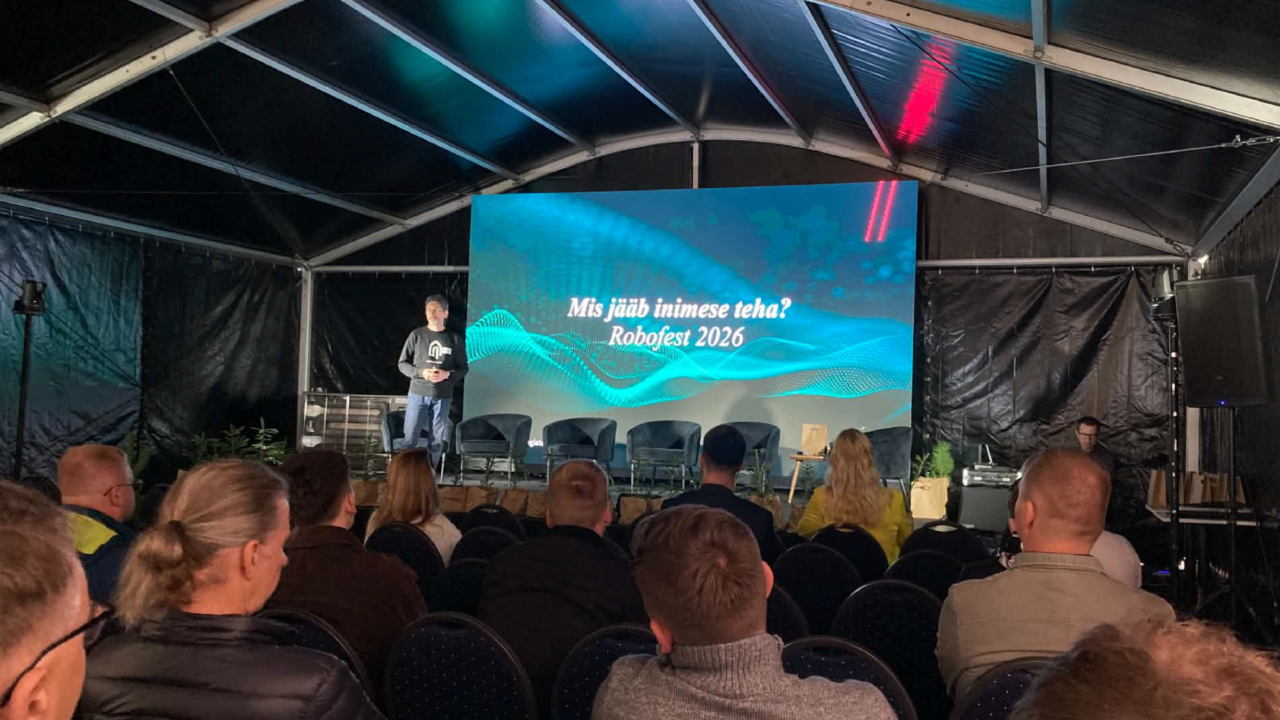
After my presentation at Robofest, I was asked whether I would be willing to travel from Võru to Tallinn in a self-driving car. My car has some self-driving capabilities, but I have also switched the system off after its lane-keeping assistance tried to steer me off the road twice while driving from Tallinn to Tartu.
With a fully self-driving car, we essentially expect complete certainty that the system will not make a mistake. At the same time, I am convinced that driver assistance systems are essential for saving lives. For example, when following a lorry at a distance of just a few metres, a driver may not react quickly enough if it brakes. In such a situation, a machine can be faster than a person and prevent an accident.
The right question, therefore, is not whether humans or machines are better. We should ask which tasks we can trust machines to perform, when people must retain control, and how to design a system in which human and machine strengths complement one another.
The more robots can take tedious, boring and overly demanding work off our hands, the more time we have to set goals, assess situations, make reasoned decisions and take responsibility for their consequences. We also have more time to enjoy life! That is precisely what remains for humans to do.
Share this entry