News

For a Better Estonia: Greater AI Impact Through Collaboration
Anne Muldme
Head of Marketing, AIRE
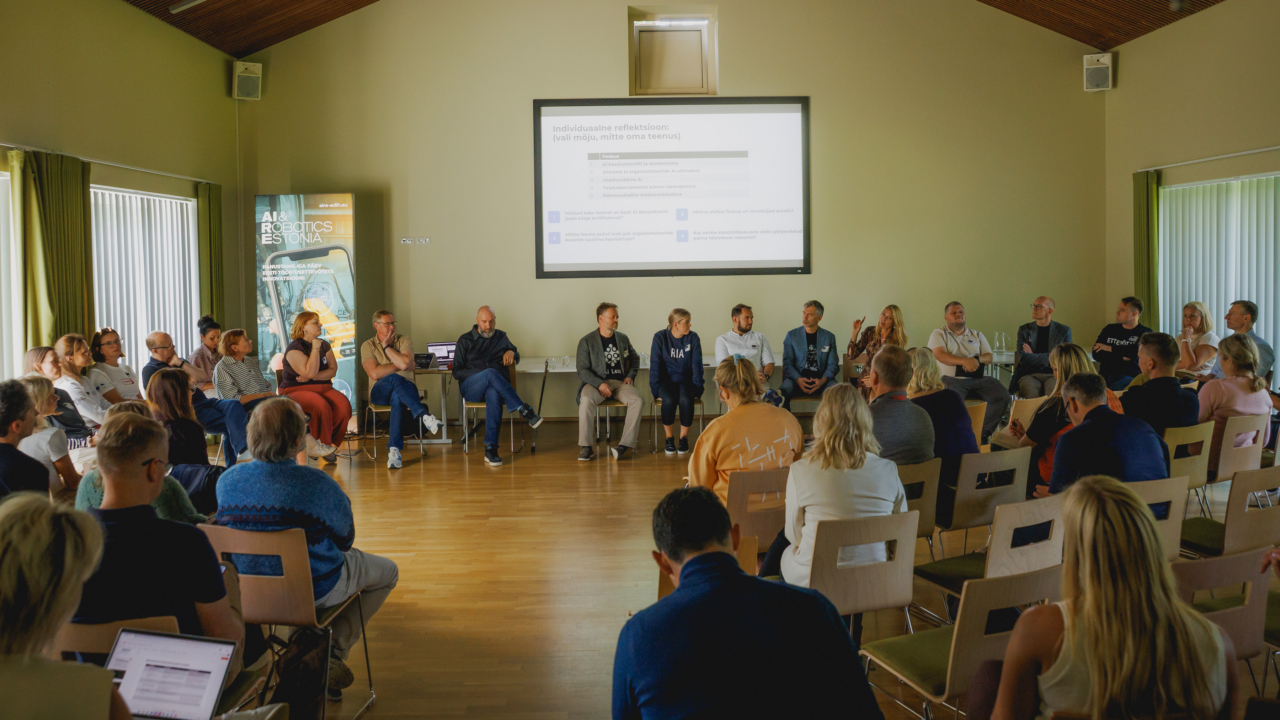
At the end of August, representatives of 17 organisations supporting and driving AI development in Estonia gathered at Särghaua. Together, they explored opportunities for collaboration to keep pace with rapidly evolving technology and strengthen Estonia’s global competitiveness.
Ahead of the meeting, participants shared their organisations’ objectives, expertise, near-term priorities and roles in the AI ecosystem. Their input revealed that their main shared customer is the Estonian business seeking to adopt new technologies to increase productivity, competitiveness and exports. Other major customer groups include the public sector, research and education organisations, and various population groups.
Overlapping yet distinct expertise
For many participants, connecting research and business is central to their value proposition, but their roles differ. These include generating new knowledge, finding research partners, assessing quality, providing funding, acting as development partners and supporting AI adoption.
Their shared expertise centres on research, business needs and an environment that enables innovation. Participants described their roles in the AI ecosystem primarily in terms of creating and enabling, while responsibility for overall outcomes and the end-to-end journey remains largely unaddressed.
Participants identified fragmentation across sectors and organisations, as well as the dispersal of efforts among numerous smaller initiatives, as key challenges. They noted positive progress in information sharing between organisations and in identifying and jointly leading work on important shared issues.
For the roundtable discussions, participants were divided into four broad groups: business representatives (the Estonian Association of Information Technology and Telecommunications, the Federation of Estonian Engineering Industry, the Estonian Chamber of Commerce and Industry, Swedbank AS and STACC OÜ); policymakers (the Ministry of Economic Affairs and Communications, Eesti.ai and the City of Tallinn); policy implementers (the Estonian Business and Innovation Agency, the Estonian Research Council, the Information System Authority, TI-Hüpe and the Institute of the Estonian Language); and experts and networks (TalTech, the University of Tartu’s EXAI, AIRE and Adapter).
Five priorities for collaboration
Before the roundtable, the participants’ collective input had highlighted five priorities that would benefit from joint efforts:
- AI adoption and scaling;
- AI capabilities among individuals and organisations;
- trustworthy AI;
- faster application of research expertise;
- international competitiveness.
The discussion added five further important topics:
- AI infrastructure and shared ownership of data;
- a repository of case studies;
- the creation of additional financing instruments;
- the availability of AI services in Estonian;
- technological dependence and security.
All the priorities identified span multiple organisations and areas of responsibility. Maintaining a shared focus would help advance AI-driven development across Estonia and enable a more purposeful, coordinated and clearly directed contribution to the Estonian economy.
Focusing on AI adoption and scaling
AIRE took the initiative to convene the next gathering in the autumn to advance work on AI adoption and scaling. The meeting will provide an opportunity to share ideas and discuss possible next steps.
Estonia’s small size is often also a strength. With a shared understanding of a clear and important goal, and the willingness to act, we can move very quickly across organisations. AIRE has extensive experience of collaboration within its network and can offer good practices for working swiftly and purposefully across large research organisations. We now intend to scale up this collaborative approach and apply it to the development of Estonia’s AI ecosystem, working towards a better and more competitive Estonia.
Share this entry