News

AIRE panel at the EPA fair: AI must deliver clear benefits for businesses
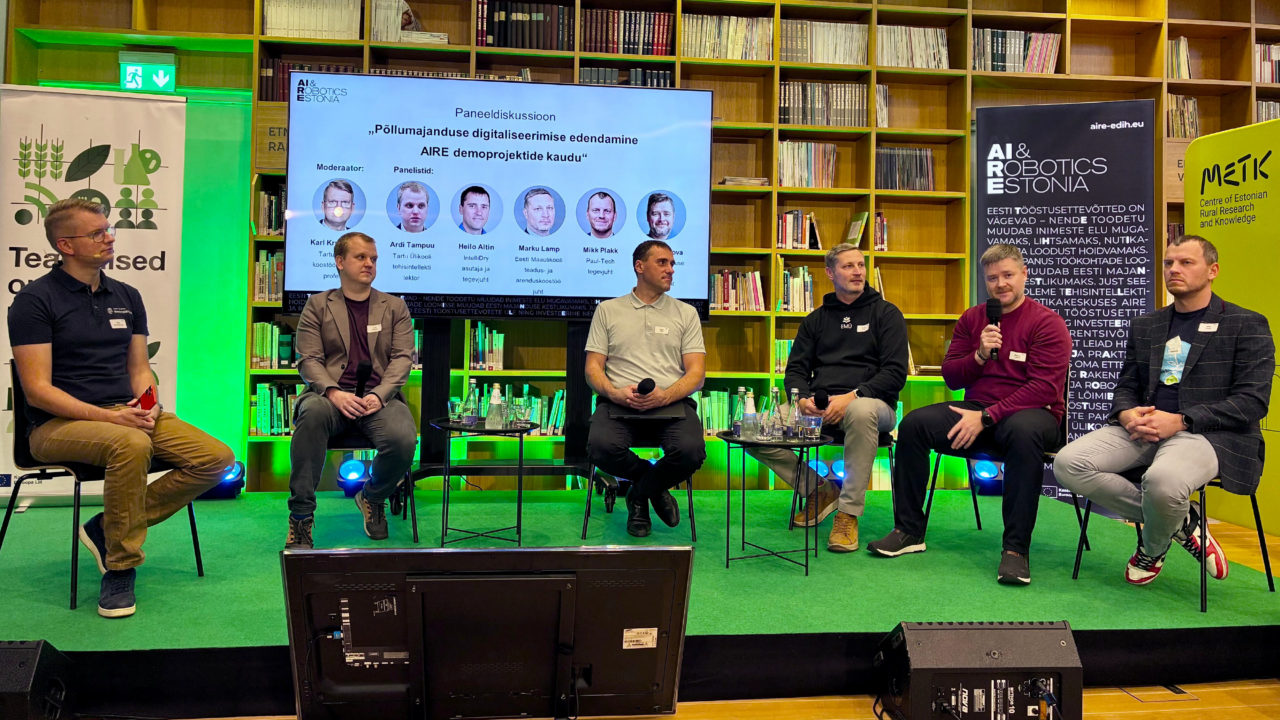
At the AIRE panel discussion held during the EPA fair at the Estonian National Museum on 14 October, business leaders and university representatives explored how artificial intelligence can help agriculture and the food industry save time, reduce costs and improve production efficiency. A key takeaway was that adopting new solutions requires more than technology: high-quality data, employee involvement and a clear understanding of the expected benefits are equally essential.
Moderated by University of Tartu Professor Karl Kruusamäe, the panel featured Heilo Altin from IntelliDry; Mikk Plakk, CEO of Paul-Tech; Marku Lamp, Head of Research and Development Cooperation at the Estonian University of Life Sciences; Ardi Tampuu, Lecturer in Artificial Intelligence at the University of Tartu; and Ragnar Loova, CEO and CFO of Nõo Lihatööstus.
The businesses’ experiences showed that one of the most challenging aspects of digitalisation is turning collected data into actionable insights for everyday work. Agriculture already uses a wide range of equipment and software, but bringing together information from different systems to create a comprehensive picture still takes effort. It is also essential to consider the people who will use the new solutions and enter the necessary data.
Heilo Altin introduced IntelliDry’s development work, which aims to make grain dryers more efficient through machine learning. A model that predicts grain moisture content allows operators to monitor drying progress on their phones while carrying out other tasks. More precise control could also help reduce overdrying and energy consumption. Altin stressed that collecting reliable data took considerable time at the start of the development process. Promising results from AIRE demonstration projects gave the company the confidence to continue development, although further work is needed to assess the solution’s return on investment.
The example from Nõo Lihatööstus highlighted the potential of machine vision in quality control. Ragnar Loova described a solution tested in cooperation with the University of Tartu that checks packaging, labels and the legibility of dates on the production line. On a fast-moving line, this work demands constant attention from employees, and mistakes can be costly for the company. According to Loova, employees were initially hesitant about introducing AI, but their attitudes changed once they saw how the solution reduced routine work and supported quality assurance.
Mikk Plakk, CEO of Paul-Tech, which collects and analyses soil data, highlighted the benefits of AI in processing large volumes of data, preparing reports and supporting marketing activities. However, automatically generated conclusions still need to be checked: agricultural outcomes depend on many interconnected factors, and domain expertise plays an important role in interpreting the data. More precise information about soil and growing conditions helps businesses assess how to use inputs more efficiently and improve profitability.
Ardi Tampuu recommended starting with tasks where a reasonable amount of effort can deliver noticeable time or cost savings. For example, AI can help locate information in documents needed to prepare a report, while leaving the final assessment and verification to a person. He also emphasised that there is a significant development gap between a model that works on test data and a solution that performs reliably in a company’s day-to-day operations.
Marku Lamp highlighted the importance of cooperation between universities and businesses, as well as research data collected over long periods. The discussion also addressed trust in data sharing: businesses need to understand how their data will be used and what benefits the cooperation will bring them.
Closer cooperation between agricultural producers, technology companies and researchers was identified as an opportunity for Estonia to test new solutions in local businesses and develop technologies for export. AIRE demonstration projects support this by bringing together companies’ practical needs and researchers’ expertise, enabling solutions to be tested in real working environments.
AIRE invites Estonian businesses to submit applications to its call for demonstration project ideas, which enables companies to test and validate innovative AI and robotics solutions before investing, in situations where market failures hinder such activities. AIRE’s demonstration project service allows businesses to try out AI and robotics technologies before making an investment and encourages investment in digital technologies. The application deadline for the AIRE demonstration project call is 30 November.
Share this entry